Case Study6 min
Case study: How De Hart Temperature Controlled Transport saves 80% time with AI Order Entry
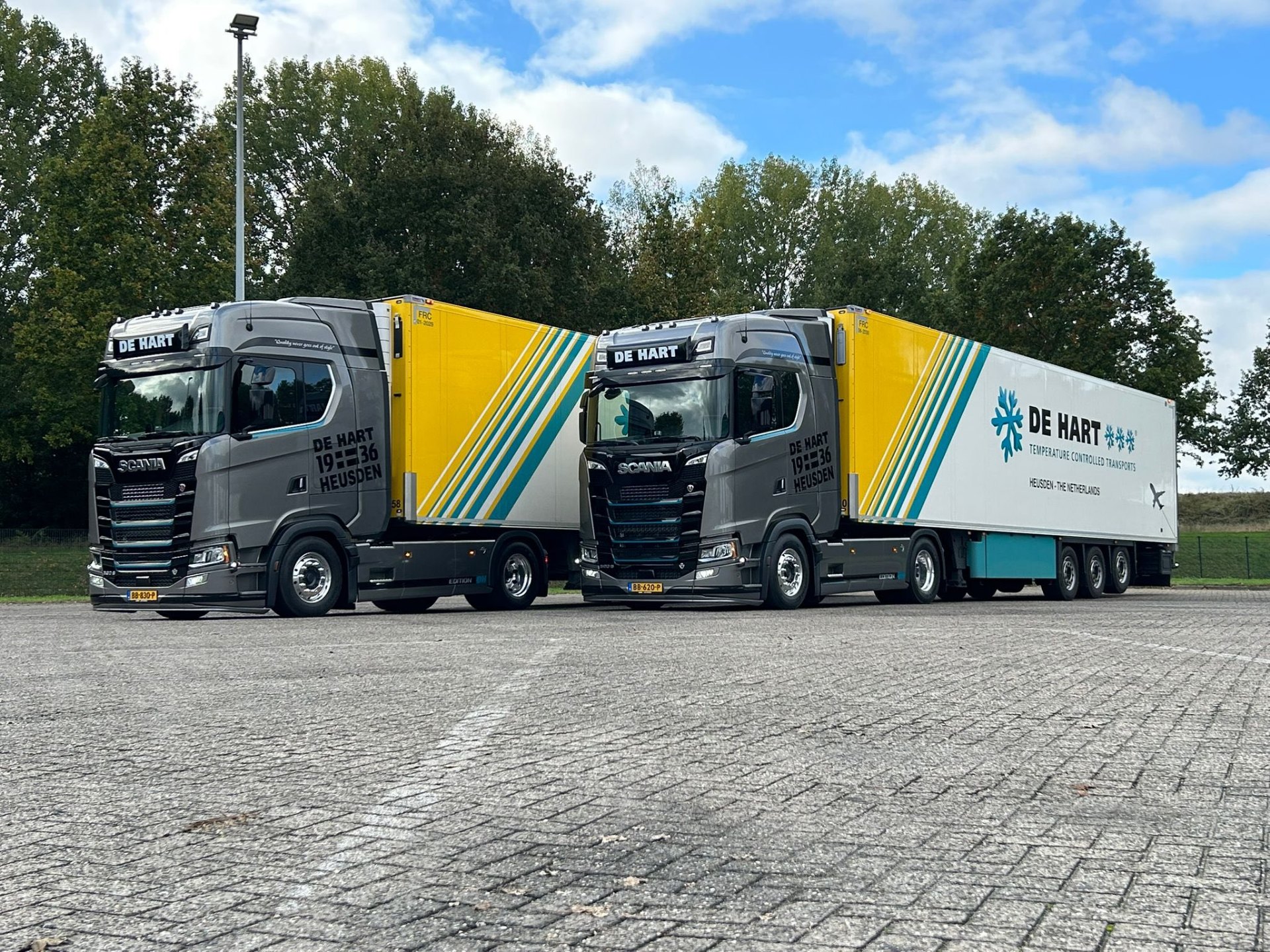
De Hart Temperature Controlled Transport now spends 80% less time processing transport orders. Where planners and order processors used to retype every order into the TMS by hand, Adabt's AI Order Entry reads orders automatically and prepares them in the transport management system. In this case study you will read how we approached it, why the connection runs via the Open Trip Model (OTM) and what results De Hart achieves.
The starting point: retyping orders
In temperature-controlled transport every minute counts, yet order entry at De Hart was largely manual work. Shippers and customers send their orders in all kinds of ways: as a PDF attachment, in the body of an email or as an Excel list. No two customers use the same format.
This had clear consequences:
- A lot of time per order. Addresses, loading and unloading dates, temperature requirements and quantities were copied into the TMS by hand.
- Error-prone. A mistyped postcode or a missed temperature setting only shows up on the road.
- Peaks are hard to absorb. At busy moments order entry falls behind, precisely when planning needs to be finished quickly.
- Knowledge sits in people's heads. Only the regular order processor knew which customer used which unusual notation.
“When our order entry employee left us, we realised how much knowledge sits in one person's head. We have transferred much of it to the AI application.”
Classic EDI connections only partly solve this: not every customer can or wants to deliver an EDI message. De Hart therefore looked for a solution that works with orders as they arrive today.
The solution: AI Order Entry
AI Order Entry automatically reads incoming orders, regardless of format. The order processor only checks and no longer needs to type.
This is how it works in practice:
- Receive. Orders arrive in a dedicated mailbox, as email, PDF or spreadsheet.
- Extract. An AI model recognises the relevant data: customer, loading and unloading addresses, time windows, goods, quantities and temperature range.
- Validate. The extracted data is checked for completeness and logic, such as valid postcodes and an unloading date after the loading date. Doubtful cases are flagged for a human check.
- Translate to OTM. The order is converted into a standardised OTM message.
- Create in the TMS. The TMS receives the order and makes it ready for planning.
Processing is tuned to the order formats of De Hart's customers. We add new customers or different formats without building a new connection.
Distinctive: the TMS connection via OTM
What makes this implementation special is that the connection to the TMS runs entirely via the Open Trip Model (OTM). OTM is an open, standardised data model for exchanging transport data such as shipments, locations, trips and vehicles.
Instead of a custom connection between the AI solution and a specific TMS, both sides speak the same language. That brings three benefits:
- Future-proof. If De Hart ever switches TMS, order processing keeps working as long as the new system supports OTM.
- Faster go-live. Because the data model is already defined, we do not need to agree field by field what an order looks like. The discussion is about content, not format.
- Reusable. The same OTM messages can be used for other flows, such as status updates to shippers or exchange with charters.
For us, this is exactly why we have supported OTM from the start: standardisation is what makes innovations like AI truly scalable in logistics.
The implementation: step by step
We took a phased approach, so De Hart saw results from the first week without disrupting daily operations.
- Inventory. Together with the order department we mapped the main customers, their order formats and the required fields in the TMS.
- Pilot with a few customers. We started with a limited number of high-volume customers. Extracted orders were first compared with manual entry to assess quality.
- OTM connection live. Once quality was in order, orders went directly into the TMS via OTM.
- Roll-out to more customers. For each customer we added the order format and tuned the checks.
- Continuous improvement. We use corrections by order processors to further sharpen recognition.
The results: 80% less time per order
The key result: De Hart spends 80% less time on order entry. What remains is checking and handling exceptions, instead of retyping.
We also see:
- Fewer entry errors, because data is no longer copied by hand and is validated automatically.
- Faster lead time from receipt to planned order, so planning is finished earlier.
- Absorbing peaks without extra staff, because processing scales with volume.
- More time for customer contact and planning, the work where the order department really adds value.
What we learn from this
The De Hart case shows that AI in order processing only truly pays off in combination with an open standard.
- Start small and measurable. A pilot with a few large customers quickly provides proof and support within the order department.
- Keep the human in the loop. Let the AI do the typing and the order processor the exceptions. That builds trust and better quality.
- Choose a standard like OTM. The TMS connection is then not dependent on one supplier and the solution is reusable for other flows.
Curious what AI Order Entry can do for your order department? Contact us for a no-obligation conversation. We are happy to look at your order flows and the possibilities of an OTM connection with your TMS.